Emerald ash borer can cause serious damage to ash trees, but a thinning canopy or damaged bark does not automatically mean your tree is infested or needs to be removed.
The emerald ash borer (EAB) is an invasive beetle whose larvae feed beneath the bark of ash trees. Because much of the damage happens out of sight, an infestation can be difficult to recognize in its early stages. By the time obvious symptoms appear in the canopy, the insect may have already been present for some time.
If you are concerned about an ash tree on your property, start by determining whether it is actually an ash, looking for possible signs of emerald ash borer and evaluating the tree’s overall condition. From there, a professional can help determine whether monitoring, emerald ash borer treatment or removal is the appropriate next step.
What Is Emerald Ash Borer?
Emerald ash borer is a small, invasive wood-boring beetle that attacks ash trees. It was first detected in the United States near Detroit in 2002 and has since spread across much of the country.
The adult beetle is not responsible for most of the serious ash borer damage. The larvae are.
Adult beetles lay eggs in or around bark crevices. After hatching, the larvae move beneath the bark and feed on the living tissues that help transport water, nutrients and sugars throughout the tree.
As this feeding continues, the tree becomes less capable of moving those resources between its roots and canopy. Leaves can begin to thin, branches may die and the health of the tree can progressively decline.
Because the larvae remain beneath the bark for much of their development, early infestations can be difficult to detect.
First, Make Sure You Have an Ash Tree
Before looking for emerald ash borer damage, determine whether the tree you are concerned about is actually an ash.
Ash tree identification is most reliable when you look at several characteristics together rather than relying on one feature.
Opposite Branching
Ash trees typically have opposite branching. This means branches, twigs and buds generally grow directly across from one another along the stem.
Compound Leaves
Instead of having one simple leaf blade, ash trees typically have compound leaves consisting of multiple leaflets attached along a central stalk. Many ash species have five to nine leaflets.
Mature Bark
Older ash trees commonly develop intersecting bark ridges that create a diamond-shaped pattern. Younger trees may have smoother bark without the pronounced pattern found on mature trees.
Winged Seeds
Female ash trees may produce clusters of elongated, paddle-shaped winged seeds.
No single feature should be used to identify an ash tree. Species and tree age can affect appearance, so look for a combination of characteristics.
It is also worth noting that mountain ash is not a true ash tree in the Fraxinus genus and is not considered a host for emerald ash borer. EAB primarily attacks true ash species, although white fringetree has also been documented as a host.
You do not need to identify the exact ash species before asking for help. If several characteristics indicate that you have an ash tree and you are noticing unusual symptoms, further assessment may be worthwhile.
What Does Emerald Ash Borer Look Like?
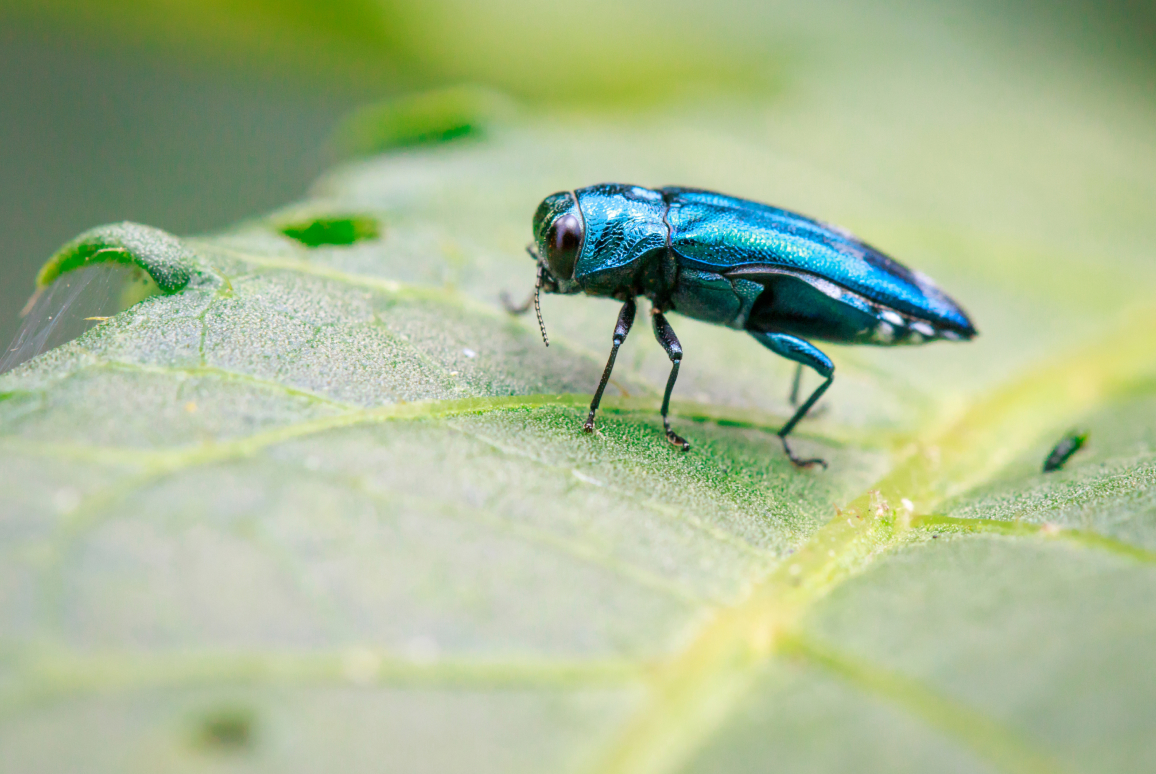
Adult emerald ash borers are small, narrow beetles with a distinctive metallic-green appearance. Adults are approximately 3/8 to 1/2 inch long.
Emerald ash borer larvae look completely different.
The larvae are cream-colored, flattened and segmented. They develop beneath the bark, where they feed on the tree’s living tissues, and can reach approximately 1.5 inches in length when fully grown.
However, homeowners are often more likely to notice evidence of an infestation than the insects themselves.
Adult beetles are small and seasonal, while larvae remain hidden beneath the bark for much of their development. Not seeing an adult emerald ash borer does not mean your tree is free of EAB.
Likewise, not every metallic-green beetle is an emerald ash borer. Look for additional evidence before assuming a green insect found near an ash tree is EAB.
What Are the Signs of Emerald Ash Borer?
Recognizing the signs of emerald ash borer requires understanding the difference between physical evidence of the insect and symptoms of a stressed tree.
A sign is direct physical evidence associated with the insect, such as an exit hole, larval gallery or larva.
A symptom is the tree’s response to stress, such as thinning foliage or dying branches.
This distinction matters because many EAB symptoms can also be caused by disease, drought, root problems and other insects.
| Sign or Symptom | What It Looks Like | Where to Look | What It Can Tell You |
|---|---|---|---|
| D-shaped exit holes | Small holes with one flattened side | Trunk and branches | Physical evidence consistent with emerging adult EAB |
| Larval galleries | Winding or S-shaped channels beneath the bark | Beneath naturally loose or split bark | Strong evidence of wood-boring insect activity |
| Canopy thinning | Increasingly sparse foliage | Often noticeable toward the top of the tree | Indicates tree stress but does not confirm EAB |
| Branch dieback | Dead twigs and branches | Often begins in the upper canopy | Can occur as internal damage progresses |
| Epicormic shoots | New leafy shoots growing from the trunk or base | Lower trunk and base | A stress response that can have several causes |
| Bark splitting | Vertical cracks or splits | Trunk and larger branches | May expose galleries beneath the bark |
| Woodpecker flecking | Patches where outer bark has been removed | Trunk and branches | May indicate woodpeckers searching for larvae |
D-Shaped Exit Holes
When adult emerald ash borers emerge from a tree, they leave small exit holes with a characteristic D shape.
These holes can be difficult to find, particularly when they occur high in the canopy.
S-Shaped Galleries
EAB larvae create winding feeding channels, or galleries, beneath the bark.
These galleries are one of the more recognizable forms of physical evidence associated with an infestation. However, you should not peel healthy bark away from a tree just to look for them.
Canopy Thinning and Branch Dieback
Damage to the tree’s internal transport system can eventually affect the canopy. Leaves may become increasingly sparse, and branches may begin dying.
Canopy decline alone does not confirm emerald ash borer because numerous tree-health problems can produce similar symptoms.
New Shoots Along the Trunk
A stressed ash may produce clusters of new shoots along its trunk or near its base. These are sometimes called epicormic shoots.
Again, these indicate stress rather than confirming the cause.
Woodpecker Activity
Woodpeckers searching for EAB larvae may remove pieces of outer bark, exposing lighter-colored bark underneath. This activity, sometimes called flecking or blonding, can become especially noticeable on heavily infested trees.
When inspecting your tree, stick to observations you can safely make from the ground. Do not climb a declining ash tree or strip intact bark to search for larvae.
How Does Emerald Ash Borer Damage Trees?
Most emerald ash borer damage happens beneath the bark.
After EAB eggs hatch, larvae tunnel into the tree and begin feeding on living tissue. As they move, they create winding galleries beneath the bark.
This feeding damages the tissues involved in transporting resources through the tree.
As the damage becomes more extensive, the tree has increasing difficulty moving water, nutrients and sugars where they are needed. The effects eventually become visible above ground.
That is why an infested tree may develop:
- Thinning foliage
- Upper-canopy dieback
- Dead branches
- Bark splitting
- Stress shoots along the trunk
The rate of decline varies from tree to tree. Existing tree health, environmental stress, infestation pressure and the amount of internal damage can all affect how quickly symptoms progress.
Rather than assuming an infested tree has a predetermined amount of time remaining, evaluate its actual condition.
What Should You Do If You Suspect Emerald Ash Borer?
If you think an ash tree may have EAB, gather some basic information before making a treatment or removal decision.
Start with photographs.
Take a picture showing the entire tree and canopy, followed by closer photographs of any unusual bark damage, exit holes, woodpecker activity, cracks or new shoots.
Then consider the tree’s surroundings.
Is it next to your home? Does it hang over a driveway, sidewalk, road or frequently used outdoor space? Are there utility lines nearby?
This information can help a tree-care professional evaluate both the possible infestation and the consequences of continued decline.
A professional assessment should help answer three separate questions:
Is this actually an ash tree?
Is emerald ash borer responsible for the symptoms?
What is the current health and structural condition of the tree?
Those questions should be considered together before deciding what to do next.
If the tree already has hanging limbs, substantial canopy decline or other apparent structural concerns, have it evaluated promptly rather than waiting for an ideal treatment season.
What Are the Emerald Ash Borer Treatment Options?
Emerald ash borer treatment is generally intended to prevent additional insect damage. It cannot reverse structural damage that has already occurred.
That distinction is important when deciding whether a tree is a good treatment candidate.
Healthy ash trees can potentially be protected before infestation becomes established. Some infested trees may also respond to treatment when sufficient healthy canopy and functioning tissue remain.
Several systemic insecticide approaches are used for EAB management.
“Systemic” means the insecticide moves within the tree so the pest encounters the active ingredient while feeding.
| Treatment Approach | How It Works | Factors Affecting Suitability | Important Limitations |
|---|---|---|---|
| Trunk injection | Insecticide is introduced directly into the tree’s vascular system | Tree size, health, product, existing damage and application timing | Does not repair damage that has already occurred |
| Soil treatment | Certain systemic insecticides are applied to soil and absorbed through the roots | Tree size, soil conditions, site and product | Application restrictions and effectiveness vary by product |
| Bark or trunk treatment | Certain products are applied to the lower trunk and absorbed into the tree | Product, tree size, site and timing | Not every EAB insecticide can be applied this way |
Active ingredients used for EAB management can include emamectin benzoate, imidacloprid and dinotefuran. The appropriate product and application method depend on the individual tree, site and current product labeling.
For example, emamectin benzoate products used for EAB management are administered through trunk injection and certain products require professional application.
Roots offers professional tree injections for pest and disease management, including borers. A tree assessment can help determine whether treatment is appropriate and what approach should be considered.
It is also important to distinguish an EAB insecticide treatment from a general nutrient injection.
Nutrients may be useful for addressing certain tree-health needs, but providing nutrients does not replace an insecticide specifically intended and labeled for emerald ash borer control.
When Should an Ash Tree Be Treated for Emerald Ash Borer?
There is no universal month when every ash tree should receive EAB treatment.
Appropriate timing depends on factors including:
- The treatment method
- The specific product
- Tree condition
- Local growing conditions
- Product label requirements
The right time to assess a tree and the right time to apply a particular treatment are also different questions.
If your ash tree is showing concerning symptoms, do not postpone an assessment simply because you think you have missed the treatment season.
Treatment should also be viewed as an ongoing management plan rather than a permanent cure.
Depending on the insecticide and application method, protection may last for a limited period before another application is required. Continued monitoring and repeat treatment are therefore important considerations when deciding whether long-term preservation makes sense.
Can an Ash Tree With Emerald Ash Borer Be Saved?
In some cases, yes.
However, not every infested ash tree is a good candidate for treatment.
A professional may consider several factors before recommending preservation or removal, including:
- Current canopy condition
- Amount of existing EAB damage
- Overall health
- Structural condition
- Other diseases or tree-health problems
- Location on the property
- Landscape and shade value
- Feasibility of continued treatment
Treatment generally has a better chance of success before extensive decline occurs.
However, homeowners should be careful about trying to diagnose treatment suitability based on a canopy-loss percentage found online. Published guidance varies depending on treatment method, tree condition and other circumstances.
The condition of the individual tree matters more than applying one universal percentage.
| Situation | What a Professional May Evaluate | Possible Direction |
|---|---|---|
| Apparently healthy ash with EAB exposure | Tree health, preventive protection and long-term value | Treatment may be considered |
| Suspected EAB with limited decline | Diagnosis, existing damage and likely treatment response | Assessment before selecting treatment |
| Extensive decline or structural concerns | Safety, remaining tree function and feasibility of preservation | Removal may be appropriate |
Treatment suitability and structural safety should also be considered separately.
A treatment may control insects, but it cannot restore wood that has already become structurally compromised.
Why Dead or Declining Ash Trees Need Attention
A declining ash tree should not automatically be considered dangerous simply because EAB is present.
However, safety becomes increasingly important as an affected tree dies.
Dead ash wood and branches can become brittle, making a severely declining or dead tree more difficult and potentially more hazardous to remove.
Location matters considerably.
Pay particular attention to declining trees near:
- Homes
- Garages and other structures
- Driveways
- Roads
- Sidewalks
- Play areas
- Frequently used outdoor spaces
- Utility lines
If preservation is no longer practical or the tree presents significant structural concerns, professional tree removal may be the appropriate next step.
Following removal, stump grinding can be used to address the remaining stump and prepare the area for future landscaping.
Stump grinding does not, however, protect nearby living ash trees from emerald ash borer.
Emerald Ash Borer Treatment Cost vs. Tree Removal Cost
Homeowners often want to know whether it is cheaper to treat an ash tree or remove it.
There is no universal answer.
The cost of EAB treatment can depend on:
- Tree diameter and size
- Treatment method
- Product used
- Frequency of future applications
- Accessibility
- Number of trees being treated
Tree removal costs can depend on:
- Tree size
- Tree condition
- Equipment access
- Proximity to buildings and utilities
- Complexity of the removal
- Debris disposal
- Stump grinding
For that reason, comparing the price of one treatment against the price of one removal does not provide the complete picture.
A more useful comparison considers the expected long-term cost of protecting the tree through repeat treatments versus removing it, addressing the stump and potentially planting a replacement.
The value of the existing tree should also be considered. A mature shade tree can provide benefits that a newly planted replacement may take years to reproduce.
An assessment can help you compare the realistic options for your particular tree rather than assuming treatment or removal is always the cheaper choice.
How to Help Prevent Emerald Ash Borer From Spreading
Emerald ash borer can spread naturally as adult beetles move to nearby trees. People can accelerate that spread by transporting infested firewood, logs and other ash material over much greater distances.
One of the simplest precautions is to buy and use firewood locally rather than transporting it long distances.
Older EAB resources may refer to a federal domestic quarantine. Those federal EAB quarantine regulations were removed in 2021, so outdated federal restrictions should not be treated as current requirements.
State, local, destination-specific or other invasive-pest requirements may still affect how wood should be transported or disposed of. Check current requirements before moving potentially infested material.
If an ash tree needs to be removed, consider replacing it with a species appropriate for the site. Planting a diverse mix of tree species can also reduce the likelihood that one future insect or disease will affect a large percentage of your landscape.
Frequently Asked Questions About Emerald Ash Borer
Should I Treat an Ash Tree That Still Looks Healthy?
Possibly. Healthy ash trees can be good candidates for preventive protection depending on local EAB exposure, tree health, location and landscape value. A professional assessment can help determine whether the tree is worth maintaining through an ongoing treatment program.
Is Emerald Ash Borer Treatment Permanent?
No. EAB treatments provide protection for a limited period. Repeat applications are generally necessary, although the appropriate interval depends on the product and treatment method.
Does a Thinning Canopy Mean My Tree Has Emerald Ash Borer?
No. Canopy thinning is a symptom of tree stress and can have many causes. Other evidence, such as D-shaped exit holes, characteristic galleries or identification of the insect itself, can provide stronger evidence of an EAB infestation.
Can I Treat Emerald Ash Borer Myself?
Some products used for EAB management may be available to homeowners, while others require professional application. Treatment suitability also depends on tree size, health, existing damage and the application method. Always follow current pesticide labeling, and consider professional assessment for large or declining trees.
Does Emerald Ash Borer Attack Trees Other Than Ash?
EAB primarily attacks true ash trees in the Fraxinus genus. Mountain ash is not a true ash and is not considered an EAB host. White fringetree has also been documented as a host, although true ash trees remain the primary concern.
What Should I Do After My Ash Tree Is Treated?
Continue monitoring the tree’s canopy and overall condition and follow the retreatment schedule associated with the specific product and treatment plan. EAB treatment can help prevent additional insect injury, but it does not immediately repair damage that occurred before treatment.
Concerned About an Ash Tree?
If you are noticing thinning branches, unusual bark damage, woodpecker activity or other possible signs of emerald ash borer, do not assume the tree automatically needs to be treated or removed.
Start by finding out what is actually happening.
Roots provides professional tree-care services throughout the Metro-East and St. Clair County region. Contact Roots to have your ash tree assessed and discuss the treatment, monitoring or removal options appropriate for its condition.